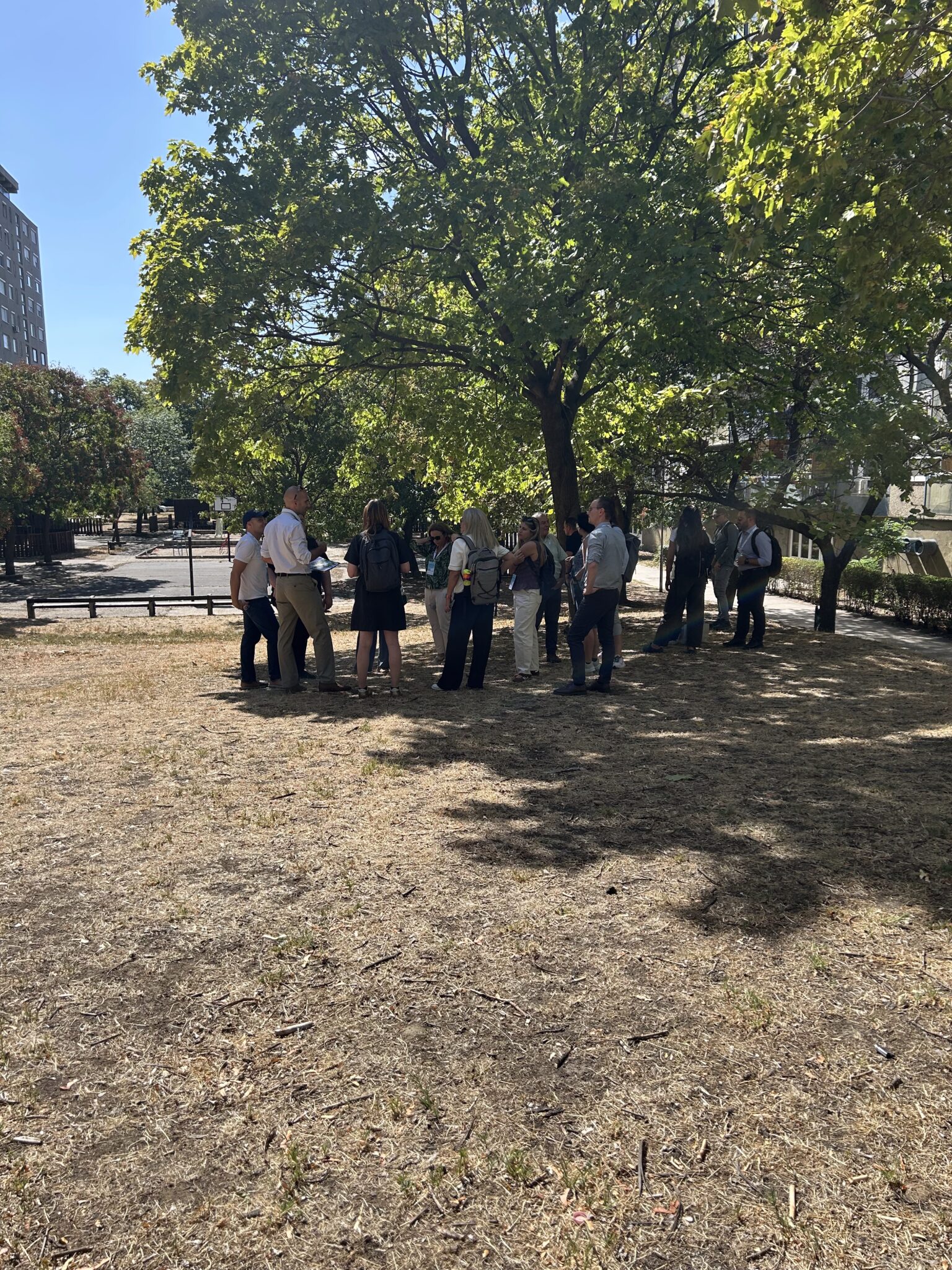
From Athens to Budapest’s 18th District — local climate adaptation from European knowledge.
Within the Cooling Havens European knowledge transfer programme, Budapest’s 18th District is examining how Athens’ innovative climate adaptation solutions can be applied in the particular environment of the Havanna housing estate. The aim is not to adopt the Athens model one to one, but to create a smaller-scale, measurable and community-based local pilot.

The Cooling Havens project is co-financed by the European Union under the European Urban Initiative – Innovative Actions.
What is Cooling Havens?
Cooling Havens is an urban development project in Athens supported by the European Union. Athens is one of Europe’s most densely built capitals with the least green space — in summer its concrete-covered squares heat up during the day and radiate that heat back at night. The project builds “cooling havens” in the most exposed neighbourhoods, where shade, vegetation and water cool the space together.
What makes Cooling Havens special is that it does not use drinking water for cooling. It collects and recirculates rainwater and treated, non-potable water, while sensors control the misting gates and the irrigation — they run only when and to the extent the heat justifies. These spaces are not showcases of engineering but community meeting points, designed by residents together with professionals.
Budapest’s 18th District Transfer City: it is not building in Athens but learning what could work from this at home.
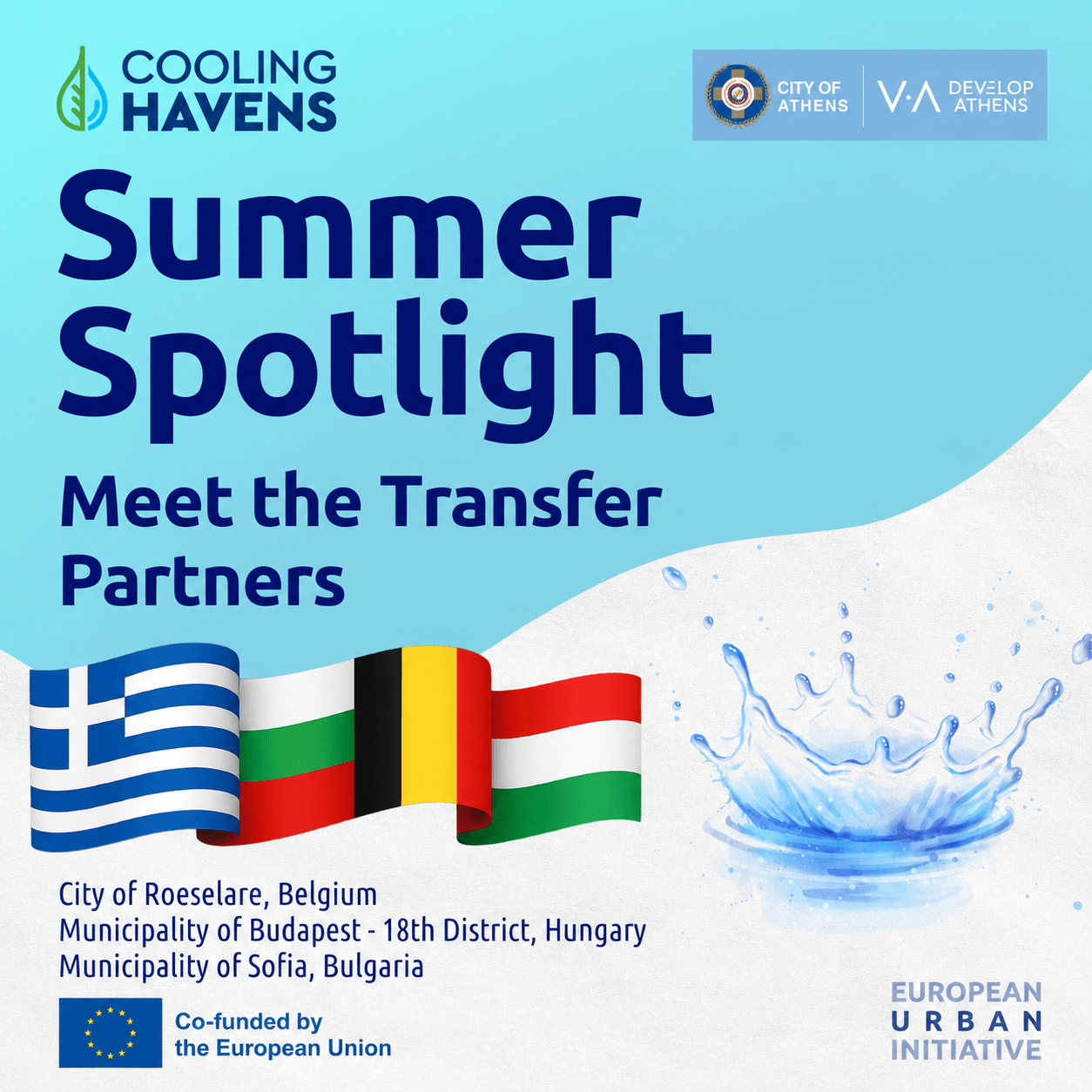
We are not adopting the Athens model as it stands. We are examining which solutions can work in Budapest’s climatic, legal, institutional and financial environment — and what has to be done differently on a housing estate in a continental climate.
Athens Budapest 18th District
The site
The pilot site is the municipally owned area behind Havanna Street 64–75 — a currently under-used play and walk-through space where summer heat, pedestrian traffic and community needs all meet.
The Havanna estate is a suitable testing ground because in one densely built, clearly bounded urban environment it brings together everything that climate adaptation has to answer for:
The aim is for the area to become a more multifunctional, greener, cooler and more communal climate-adaptive space. The district is not starting from zero: earlier rain gardens, stormwater retention and awareness-raising provide the base — Cooling Havens is the next step, connecting blue-green infrastructure, sensor-based measurement and community design in one concrete intervention.
The area behind Havanna Street 64–75
1181 Budapest, Havanna housing estate · municipal property
Open the map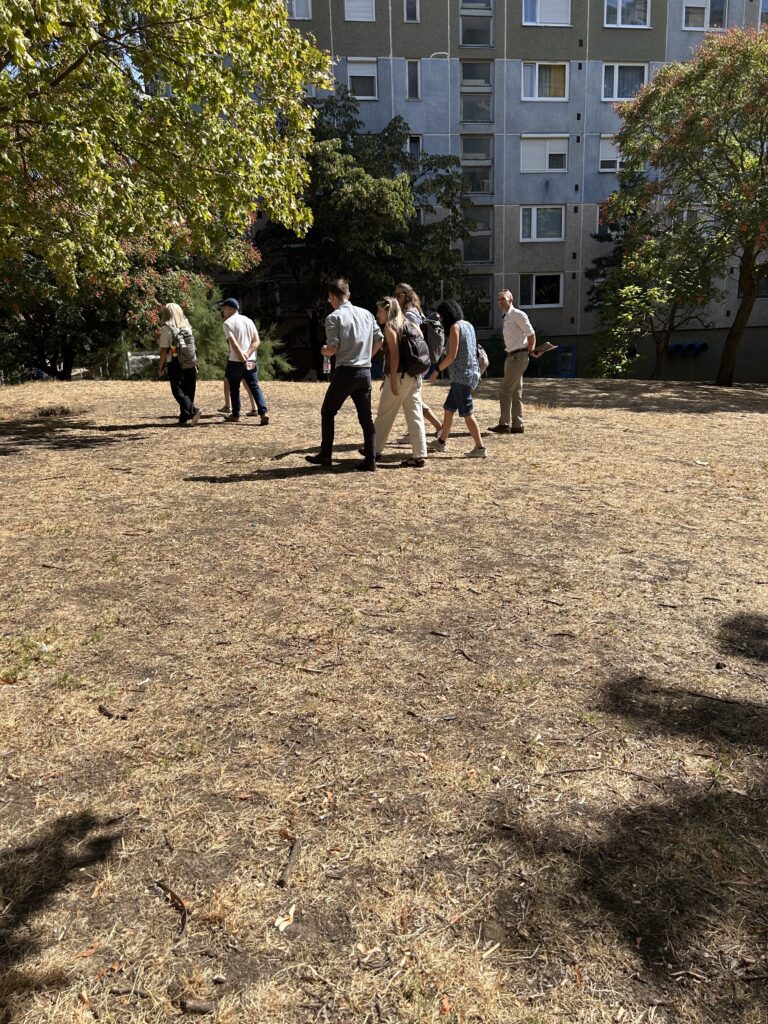
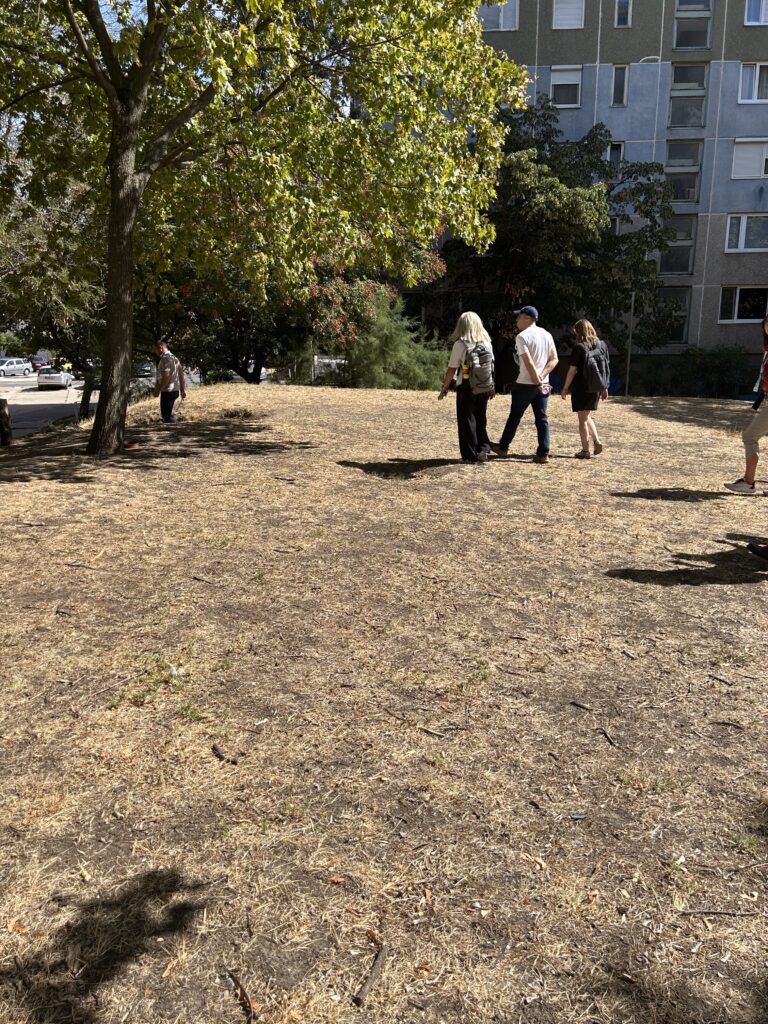
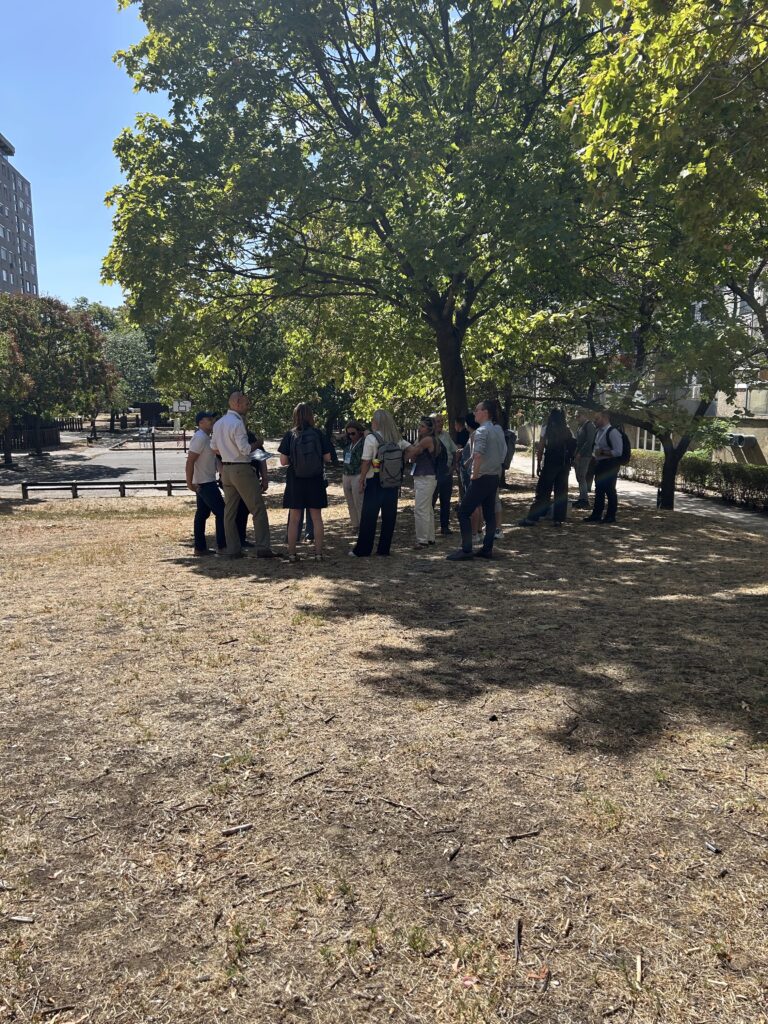
EUI Cooling Havens site visit in Budapest’s 18th District with international delegations – 8 September 2026
The first wave
Six elements that can be tested locally, at a smaller scale and measurably — these form the core of the Budapest pilot.
Trees, canopies and shading structures at the hottest points; drought-tolerant vegetation that cools and binds dust.
Rearranging the space: play, sport, rest and passage in separate zones, so that different users do not disturb each other.
Irrigation that responds to soil moisture sensors and the weather — as much water as needed, when it is needed.
Continuous measurement of temperature, humidity, soil moisture and use of the space — so that we know what changed from data, not from impressions.
Modest-scale, permittable cooling elements — misting gate, cool paving — where the measurements show the greatest heat load.
By involving residents we identify local needs. Their suggestions and feedback, together with the perspectives of local institutions and the operator, shape the plans.
The most complex elements of the Athens system are built on the water cycle. In Budapest these require separate legal, health, technical, operational and life-cycle assessment , which is why they are not part of the first-wave implementation. We have not decided on them — we are examining whether they can come into question here at all, and on what conditions.
The first-wave pilot is deliberately designed not to depend on these: if one element cannot be permitted or is not economical, the rest will still be delivered.
Monitoring
The pilot is successful if it can prove that the space became cooler, that more people use it, that it works reliably, and that the experience can be used elsewhere. We measure six areas — the data will appear here after the pilot starts.
Near the community spaces – where suitable sensors are available – we also measure the concentration of fine particulate matter and the intensity of UV radiation.
Soil moisture, irrigation events, the breakdown of water sources used, and the operator’s logs.
Visitor numbers, movement patterns, dwell patterns and structured observation — who uses the space, when and for what.
Participation in the workshops, perceived comfort, safety and usability — through questionnaires and conversations.
The survival of the planted vegetation, the performance of the shading and the quality of maintenance — the continental winter is the real test.
Downtime, faults, vandalism, repair time and replacement needs — the system is only good if it works reliably.
The success indicators come from the monitoring framework of the Transfer Roadmap: microclimate, use of the space, resident feedback, operational reliability, vegetation and the replication decision.
Community design
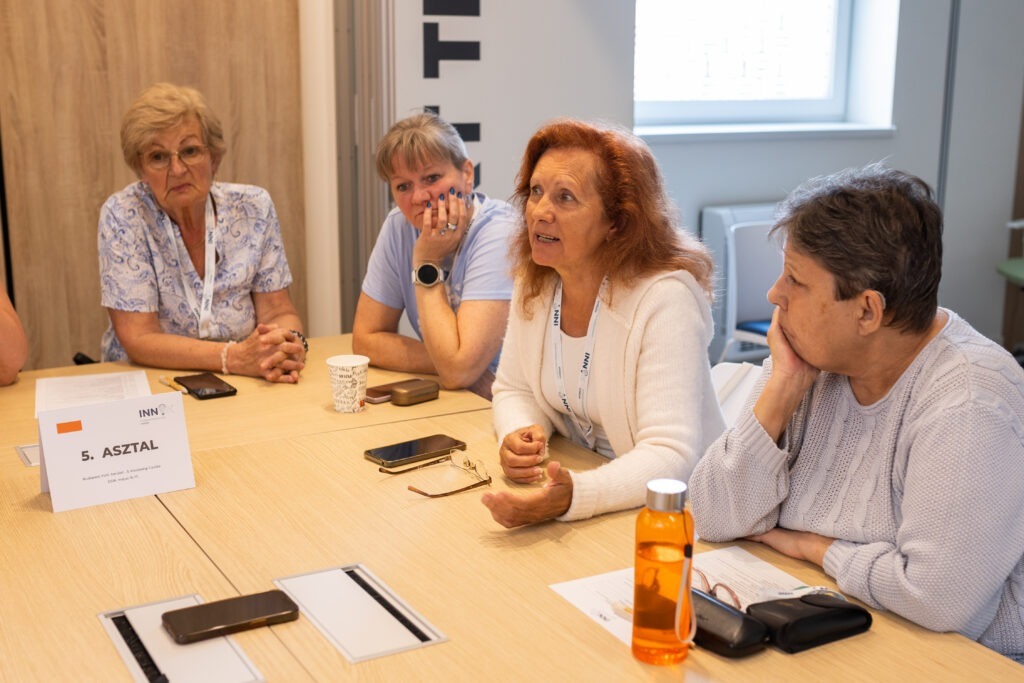
Local adaptation is not decided on an expert’s drawing board. Involving residents is part of the process, not a consultation added afterwards:
Knowledge transfer
The Cooling Havens transfer process is built on learning, local adaptation, feasibility testing and, at the end, transfer results that can actually be used.
The path of the project
Strategic preparation
Reduced-scale scope, decision path, Local Transfer Brief, baseline measurement framework.
Local adaptation and co-design
Site walks, needs assessment, the Havanna concept with Cooling Havens elements, fixing the concept.
Technical preparation
Water source and regulatory memo, blue-green concept, sensor and data architecture, operating concept.
Pilot preparation
Procurement packages, selection of the contractor, incorporating the lessons of the Athens Deep Dive.
Pilot
Construction, greening, commissioning of sensors and irrigation, test operation in the warm season.
Evaluation and learning
Measurement data, resident feedback, operator logs, peer review — draft Transfer Study.
Replication and dissemination
Replication list, financing and governance plan, final Transfer Study, communication package.
Preparation of the project and the roadmap
The Transfer Partner role, the local adoption plan, designating Havanna as the pilot site.
Budapest Site Visit
The consortium partners on the Havanna estate — site walk, peer review, professional feedback on the concept. About the event →
Technical and procurement preparation
Incorporating the lessons of the Site Visit; compiling the procurement packages.
Athens Deep Dive
The last technical calibration point before construction: water regulation, IoT, sensor protection, smart irrigation, operation.
Physical pilot and operation in the warm season
Construction, commissioning, community stewardship during the summer season.
Evaluation and Transfer Study
What worked, what did not, and what can be replicated elsewhere in the district.
Source: Transfer Partner Roadmap, V3 — the dates may change as the project progresses.
Event
Actors
Political commitment and decision; the approval path, budget and procurement; fitting the pilot into the district’s development, operation and asset management processes.
The professional coordinator of the project: knowledge transfer, local adaptation, research and monitoring, facilitating community design, and producing the transfer documentation and the reports.
The City of Athens as project owner, the Delivery Partners (water utility, technical university, landscape architects, circular water management, community innovation) and the Transfer Cities: Roeselare and Sofia.
The partners of the project




The Cooling Havens project is co-financed by the European Union under the European Urban Initiative. The logos appear in line with the official visibility requirements of the project.
One project — three perspectives
The three labs of InnoK show the same project from three sides. Every piece of content has one primary home — the other two lead there.
The urban intervention
The project itself and the Havanna pilot: what is being built, where, when and with whom — this page.
You are hereThe knowledge, measurement and experimentation
Research, SWOT, stakeholder map, monitoring methodology, knowledge transfer and the later case study.
livinglab.hu → Civic LabThe community participation
Resident involvement, co-design, consultations and the results of the participatory process.
civiclab.hu →