
Transformative social innovation
Transformative social innovation
Transformative social innovation refers to change processes that not only provide a new answer to a specific problem, but can also transform the deeper rules, relationships and institutions of social functioning. It focuses on cooperation between multiple actors, community participation and long-term, systemic impact.
Transformative social innovation refers to a change process that not only provides a new answer to a specific problem, but can also shape deeper patterns of social functioning. The essence of this is that innovation does not remain within the framework of a single organization or sector, but creates new relationships between state, market, civil and community actors.
More than a one-time solution
Social innovation often starts from a well-defined need. However, the transformative approach also pays attention to the broader relationships, institutional operations and social practices in which the given problem is embedded.
Therefore, it is not only important whether a new service, program or method is created, but also whether the cooperation of the actors changes in the process. An initiative can become transformative if it goes beyond its own direct results and also affects the way the community, institutions or other actors relate to the problem.
Blurring of sector boundaries
One important characteristic of transformative social innovation is that it crosses traditional sector boundaries. The roles of the public sector, the market, civil society organisations and local communities are not sharply separated, but are interconnected.
This blurring of boundaries can create new forms of operation. For example, civil society actors can appear not only as complements, but also as initiators or intermediaries; local governments can be involved as partners; and businesses can become part of social solutions. The emphasis is not on who comes from which sector, but on whether the actors are able to jointly develop a new response.
Potential for systemic change
Transformative innovation is closely linked to the systems approach. It assumes that social problems can rarely be solved with a single intervention. More lasting change often requires actors to jointly understand the problem, try out new collaborations, and incorporate the experiences into further operations.
This is not necessarily a fast or spectacular process. Change often appears gradually: in changing institutional practices, stronger community participation, new partnerships, or in a previously isolated initiative becoming a model on a wider scale.
In summary
Transformative social innovation does not just create a new solution, but also shapes the relationships between social actors. Its significance lies in its ability to initiate more lasting, systemic changes through collaboration across different sectors.
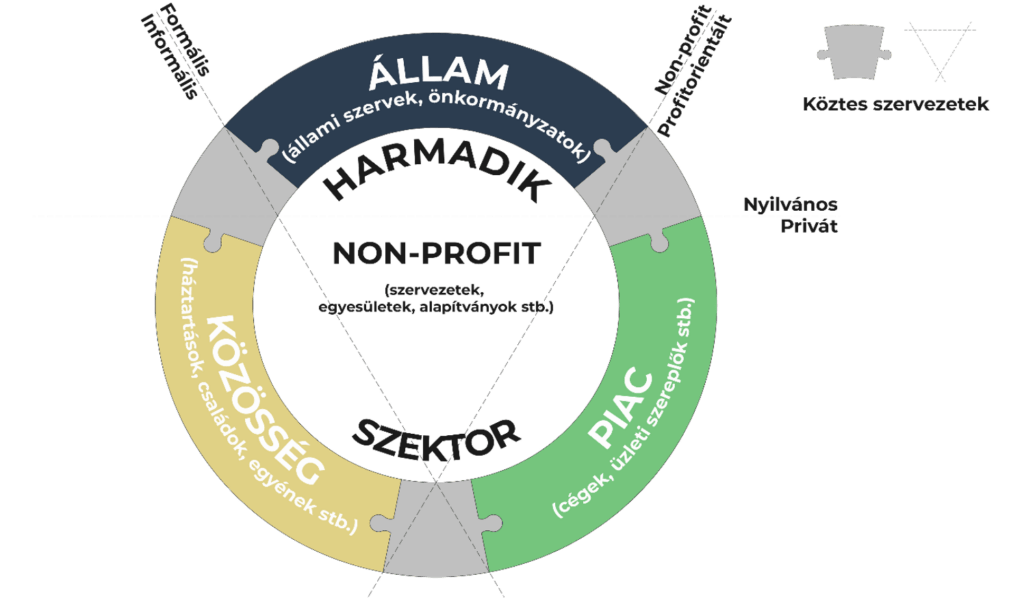
Figure. The concept of transformative social innovation
László Rónavári-Kedves (2025): The role of the civil sector in social changes. Conceptual definitions, models and examples from the domestic and international literature on social innovation. Thesis, ELTE TáTK.
Source: Avelino, F., & Wittmayer, J. M. (2016). Shifting power relations in sustainability transitions. A multi-actor perspective. Journal of Environmental Policy & Planning, 18. 5. p. 628-649, based on
author’s own editing (2025)
Contact
- 1184 Budapest, Ülloi út 286. Fsz. 10.
- info[at]urbanlab.hu
- © 2026 Copyright InnoK Tudásmenedzsment Intézet Nonprofit Kft. - All Rights Reserved.